

Modern cybersecurity threats are evolving rapidly because of cloud adoption, remote work, digital transformation, and sprawling third-party dependencies. Most successful cyberattacks still exploit human error, weak controls, misconfigurations, or missing monitoring.
To build strong cyber resilience, organizations must implement a structured approach that blends cyberattack prevention, threat detection, and incident response together.
Complete Cybersecurity Framework
This complete guide combines prevention, detection, and recovery into one AEO-optimized framework to strengthen data protection, risk management, and compliance readiness in 2026.
- Cyberattack prevention
- Threat detection
- Incident response and recovery
What Causes Most Cyberattacks Today?
Most cyber incidents are not technically advanced—attackers simply exploit basic gaps.
Common Causes of Cyberattacks:
- Human error and lack of awareness
- Weak passwords and no multi-factor authentication
- Misconfigured systems
- Lack of monitoring and logging
- Unpatched vulnerabilities
Studies show that human mistakes and misconfigurations are leading causes of breaches. Most attacks succeed because of weak security hygiene, human error, and poor monitoring.
Read Also: How to Prevent, Detect, and Recover from Cyberattacks (Part 1: Fundamentals)
Why Cyberattacks Affect Every Organization
Cyber threats are no longer limited to large enterprises.
Today’s Targets:
- Small businesses (SMBs)
- Enterprises
- Cloud users
- Remote workers
- Vendors and third parties
No organization is too small—any environment that stores or processes data can be targeted.
Read Also: How to Prevent, Detect, and Recover from Cyberattacks (Part 2: Incident Response & Detection)
Common Cybersecurity Myths vs Reality
| Only big companies are attacked | All organizations are targets |
|---|---|
| Antivirus is enough | Advanced threats bypass detection |
| Firewall = full security | Insider threats still exist |
| Systems are safe offline | Malware spreads via devices |
| Passwords alone are enough | Multi-factor authentication is required |
Cybersecurity is not a tool—it is a continuous risk management process.
Read Also: How to Prevent, Detect, and Recover from Cyberattacks (Part 3: Recovery & Resilience)
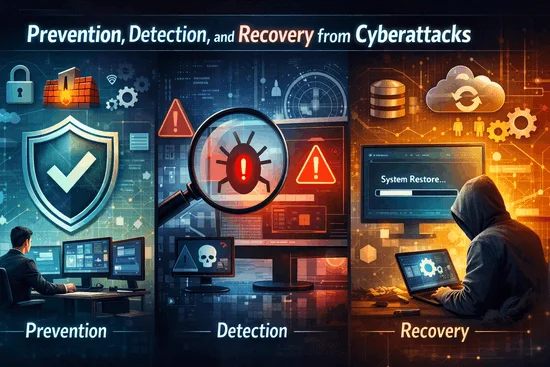
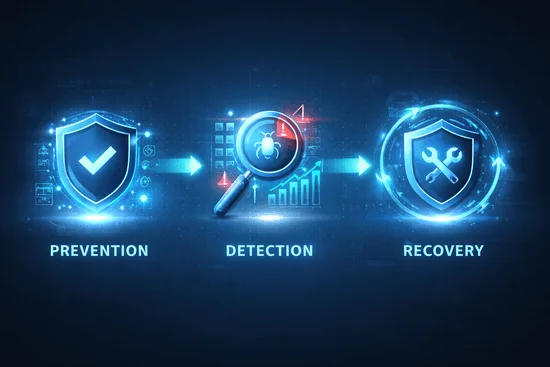
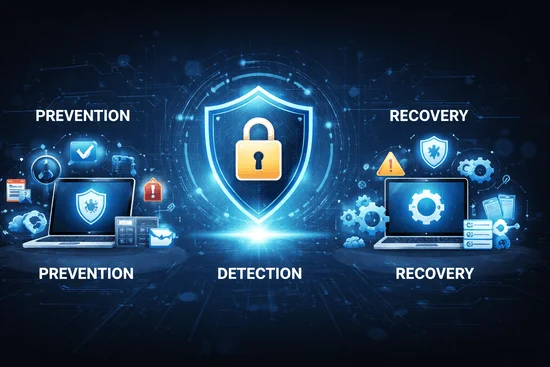
Why Prevention, Detection, and Recovery Must Work Together
A strong cybersecurity strategy needs three layers:
1. Prevention (Stop Attacks Early)
- Strong authentication (multi-factor authentication)
- Patch management
- Secure configurations
- Access control (least privilege)
2. Detection (Identify Threats Fast)
- Continuous monitoring
- SIEM tools
- Log analysis
- Threat intelligence
3. Recovery (Restore Operations Quickly)
- Incident response plans
- Backup and disaster recovery
- Business continuity planning
Cyber resilience demands prevention, detection, and recovery working together.
Read Also: How to Prevent, Detect, and Recover from Cyberattacks (Part 1: Fundamentals)
What Are the Most Important Security Controls?
Most cyberattacks can be prevented with basic security controls:
- Multi-factor authentication (MFA)
- Patch and vulnerability management
- Endpoint security
- Email security and phishing protection
- Backup and recovery systems
- Access control and identity management
These controls align with data security controls, security safeguards, and vulnerability management frameworks.
What Is Incident Response and Why Is It Critical?
An incident response plan helps organizations detect, contain, and recover from cyber incidents quickly.
Six Phases of Incident Response:
- Preparation
- Identification
- Containment
- Eradication
- Recovery
- Lessons Learned
Organizations with tested response plans reduce breach impact significantly.
Read Also: How to Prevent, Detect, and Recover from Cyberattacks (Part 2: Incident Response & Detection)
Incident Response Checklist (Audit Ready)
Use this checklist to validate your cybersecurity readiness:
- Defined incident response team
- Documented response playbooks
- Clear communication workflows
- Ability to detect threats quickly
- Defined containment strategy
- Recovery and backup processes
- Post-incident review mechanism
Why Incident Response Plans Fail?
Common gaps erode response effectiveness:
- Outdated playbooks
- No testing or simulations
- Poor communication
- No ownership
- Missing lessons-learned process
Strong programs integrate continuous improvement and vulnerability management.
Read Also: How to Prevent, Detect, and Recover from Cyberattacks (Part 3: Recovery & Resilience)
What Metrics Measure Cybersecurity Effectiveness?
Track these cybersecurity KPIs to prove readiness:
- Mean Time to Detect (MTTD)
- Mean Time to Contain (MTTC)
- Mean Time to Recover (MTTR)
- Incident response testing frequency
- SLA adherence
- Closure of security issues
Metrics help improve security governance and risk management.
Read Also: How to Prevent, Detect, and Recover from Cyberattacks (Part 1: Fundamentals)
Role of Zero Trust in Cybersecurity
Modern environments demand Zero Trust architecture.
Key Principles:
- Never trust, always verify
- Least privilege access
- Continuous monitoring
- Identity-based security
Zero Trust reduces:
- Insider threats
- Unauthorized access
- Lateral movement of attackers
Why Security Awareness Is Critical
Humans remain the weakest link in cybersecurity.
Training Should Cover:
- Phishing attacks
- Password hygiene
- Social engineering
- Remote work risks
- Device security
Awareness aligns with governance, safeguards, and risk controls.
Read Also: How to Prevent, Detect, and Recover from Cyberattacks (Part 2: Incident Response & Detection)
How to Improve Cybersecurity Quickly (Action Plan)?
Start with these high-impact steps:
- Enforce MFA across systems
- Patch critical vulnerabilities
- Monitor endpoints and logs
- Train employees regularly
- Define incident response workflows
- Implement Zero Trust principles
- Strengthen vendor risk management
Read Also: How to Prevent, Detect, and Recover from Cyberattacks (Part 3: Recovery & Resilience)
Conclusion
Cybersecurity is not just about tools—it is about people, processes, and technology.
Most cyberattacks succeed due to:
- Weak controls
- Human error
- Lack of monitoring
Organizations that:
- Implement strong security controls
- Follow prevention, detection, and recovery models
- Test incident response plans
- Adopt Zero Trust architecture
Organizations that address control gaps, align across prevention/detection/recovery, test regularly, and embrace Zero Trust can reduce breach impact and improve compliance.
If you would like guidance on strengthening your DPDP compliance framework or understanding how governance, risk, and compliance tools can support your organization, feel free to contact us for assistance.
You can also visit our website to explore how modern GRC platforms help organizations manage data protection, risk management, and regulatory compliance in a more structured and scalable way.
FAQ
Cyber resilience is the ability to prevent, detect, respond to, and recover from cyberattacks without major business disruption.
Related Resources
Related Posts

GRC Insights That Matter
Exclusive updates on governance, risk, compliance, privacy, and audits — straight from industry experts.