

Cyberattacks continue to increase as organizations adopt cloud systems, remote work, and digital platforms. Many successful breaches happen because of basic mistakes, weak controls, or human error. Strong cybersecurity programs must combine prevention, detection, and recovery practices supported by data security controls, security safeguards, vulnerability management, and security governance insights.
Studies show that human error remains one of the biggest causes of cyber incidents. Understanding common myths about cybersecurity helps organizations improve readiness and avoid preventable attacks.
Read Also: How to Prevent, Detect, and Recover from Cyberattacks (Part 2: Incident Response & Detection)
Why Human Error Causes Many Cyberattacks?
Research shows:
- Many breaches come from mistakes
- Misconfiguration causes incidents
- Weak passwords increase risk
- Poor monitoring delays detection
Security awareness must be part of security governance. Organizations should train users regularly to prevent human mistakes.
Read Also: How to Prevent, Detect, and Recover from Cyberattacks (Part 3: Recovery & Resilience)
Why Cyberattacks Affect All Organizations?
In the past, attacks primarily targeted large companies. Now, attacks target:
- Small businesses
- Individuals
- Cloud users
- Remote workers
- Vendors
Protection should follow security safeguards. No organization is too small to be at risk.
Read Also: How to Prevent, Detect, and Recover from Cyberattacks (Part 2: Incident Response & Detection)
Common Myths and Realities About Cyberattacks
| Myth | Reality |
|---|---|
| Only some industries are attacked | Any organization with data can be attacked |
| Slow computer means infection | Attackers prefer stealth |
| Firewall means safe | Insider risk still exists |
| Offline systems are safe | USB / devices can carry malware |
| Small business not targeted | Many breaches involve SMBs |
| Antivirus is enough | Zero-day attacks bypass detection |
| Up-to-date software means safe | New threats appear daily |
| Users notice infection | Modern malware hides |
| Threats come only from outside | Insider risk is real |
| VPN makes you anonymous | Other attacks still possible |
| Password Wi-Fi is safe | Public networks can be hacked |
| Security can be perfect | Security is ongoing |
| Password alone is enough | MFA required |
| Attackers rush | Many attacks are slow |
| Laws stop hackers | Attacks still increasing |
| Fast response always enough | Attackers use distraction |
| Tech solves everything | Budget limits security |
| Government stops ransomware | Many attacks succeed |
| Insurance covers loss | Not always fully paid |
Protection should include vulnerability management to address the gaps.
Read Also: How to Prevent, Detect, and Recover from Cyberattacks (Part 3: Recovery & Resilience)
Why Basic Security Controls Matter?
Most attacks exploit simple gaps in security.
Important controls:
- MFA
- Patch management
- Monitoring
- Backup
- Access control
- User training
Follow data security framework to ensure these controls are implemented effectively.
Basic controls stop many attacks before they can succeed.
Read Also: How to Prevent, Detect, and Recover from Cyberattacks (Part 2: Incident Response & Detection)
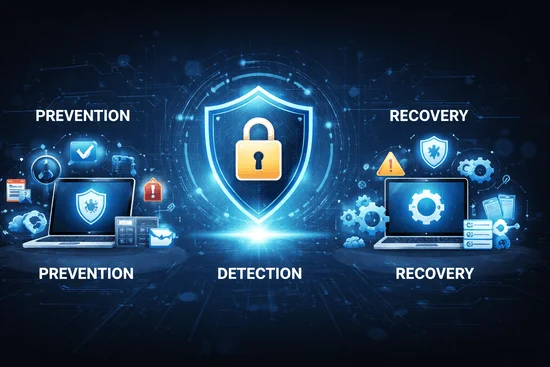
Why Prevention, Detection, and Recovery Must Work Together?
Security needs three layers:
- Prevention -> stop attacks before they happen
- Detection -> find attacks early
- Recovery -> restore systems after an attack
Programs should follow a security governance model to integrate all three components seamlessly.
Read Also: How to Prevent, Detect, and Recover from Cyberattacks (Part 3: Recovery & Resilience)
Why Awareness and Training Are Critical?
Humans cause many incidents, but training can reduce these risks. Training should cover:
- Phishing
- Password safety
- Device security
- Remote work risks
- Social engineering
This aligns with security safeguards to prevent attacks.
Read Also: How to Prevent, Detect, and Recover from Cyberattacks (Part 2: Incident Response & Detection)
Conclusion
Cybersecurity is not only about tools — it is about awareness, controls, monitoring, and response. Many cyberattacks succeed because of simple mistakes, weak passwords, outdated systems, or lack of testing. Organizations that understand common myths, enforce strong security controls, and continuously monitor risks can significantly improve prevention, detection, and recovery capabilities.
If you would like guidance on strengthening your DPDP compliance framework or understanding how governance, risk, and compliance tools can support your organization, feel free to contact us for assistance.
You can also visit our website to explore how modern GRC platforms help organizations manage data protection, risk management, and regulatory compliance in a more structured and scalable way.
FAQ
Cyberattacks often succeed because of misconfigurations, weak passwords, lack of monitoring, or human mistakes, even when security tools are installed.
Related Resources
Related Posts

GRC Insights That Matter
Exclusive updates on governance, risk, compliance, privacy, and audits — straight from industry experts.