

PII classification under the DPDP Act means identifying personal data, grouping it by sensitivity and risk, and applying suitable controls. It helps organizations know what data they collect, where it is stored, who can access it, and how it should be protected for DPDP compliance.
Overview
PII classification matters because personal data is often spread across websites, CRM, HR tools, cloud drives, marketing platforms, support systems, and vendor applications. Without classification, teams may underprotect high-risk data or fail to prove control during audits.
Under the DPDP Act, the legal term is personal data, not PII. The Act defines personal data as data about an individual who is identifiable by or in relation to such data. Organizations can use “PII classification” internally, but policies should align with “personal data.”
Key Findings
- DPDP uses “personal data,” while PII is a common security and business term.
- Classification helps identify, protect, and control personal data.
- Data should be grouped by sensitivity, purpose, access, volume, and retention risk.
- High-risk data needs encryption, masking, and monitoring.
What Is PII Under the DPDP Act?
PII means information that can identify a person directly or indirectly. Under DPDP, this is best understood as personal data.
Examples include name, email address, phone number, Aadhaar, PAN, IP address, location data, financial records, health data, biometric data, employee records, and customer account details.
Read also: Data Fiduciary Under DPDP Act
Is PII the Same as Personal Data Under DPDP?
PII and personal data are closely related, but they are not the same in legal usage.
| Term | Meaning | Best Use |
|---|---|---|
| PII | Information that can identify a person | Business and security usage |
| Personal Data | Data about an identifiable individual | DPDP legal usage |
For DPDP compliance, use personal data in documentation and PII classification to organize protection controls.
What Types of Personal Data Should Be Classified?
Organizations can classify personal data into practical risk-based groups.
1. Basic Personal Data
Routine identifiers such as name, email, phone number, employee ID, and customer ID.
2. Sensitive or High-Risk Personal Data
Data that may cause greater harm if misused, leaked, or accessed without authorization. Examples include financial details, government IDs, health information, biometric data, children’s data, and precise location data.
3. Large-Scale or Business-Critical Data
Large customer datasets, profiling data, behavioural data, analytics records, or AI-related datasets containing personal data.
Read also: Vendor Risk Management Under DPDP
Why Is PII Classification Important for DPDP Compliance?
PII classification is important because organizations cannot protect personal data properly unless they know what they collect, where it is stored, and how risky it is.
It helps businesses apply risk-based protection, improve access control, support consent accuracy, reduce breach impact, strengthen audit readiness, and make better retention decisions.
The DPDP Act considers factors such as volume and sensitivity of personal data for certain compliance obligations, which makes classification important for privacy governance.
Read also: DPDP Compliance Software in India
How to Classify Personal Data Under DPDP?
Organizations can follow a simple five-step process.
Step 1: Identify data sources across websites, apps, HR systems, CRM, cloud storage, and vendor tools.
Step 2: Categorize data fields into identity, contact, financial, employee, health, children’s, and behavioural data.
Step 3: Assign risk levels such as low, medium, high, and critical based on sensitivity, volume, exposure, and impact.
Step 4: Apply controls such as encryption, masking, access control, monitoring, retention rules, and audit logs.
Step 5: Review regularly when new systems, vendors, fields, or purposes are introduced.
Read also: DPDP Consent Management Requirements
What Are the Common Challenges in PII Classification?
Common challenges include scattered data, unstructured files, duplicate records, manual spreadsheets, unclear ownership, and limited vendor visibility.
These issues make it difficult for privacy, IT, security, and compliance teams to maintain a single view of personal data.
Read also: DPDP Compliance Automation
Why Is PII Classification Foundational for DPDP Compliance?
PII classification is foundational because DPDP compliance depends on visibility. Organizations cannot protect, restrict, retain, or govern personal data properly unless they understand its risk level.
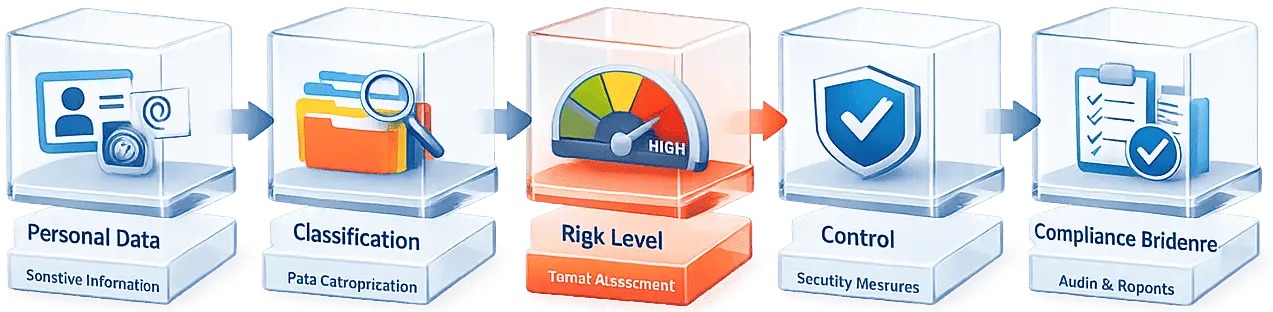
Simple model:
Personal Data → Classification → Risk Level → Control → Compliance Evidence
Conclusion
PII classification helps organizations identify personal data, understand risk, and apply suitable controls. Although DPDP uses the legal term personal data, PII classification remains useful for business, security, and compliance teams.
FAQs
It means grouping personal data based on sensitivity, risk, purpose, and protection needs.