

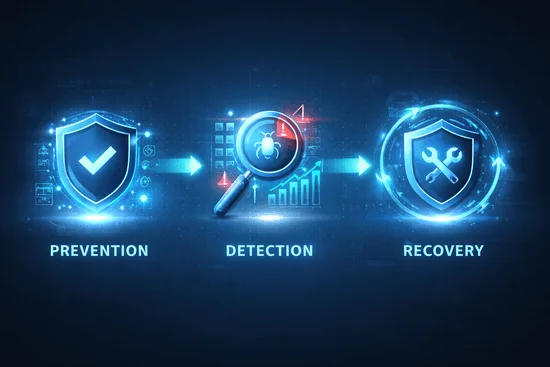
To prevent, detect, and recover from cyberattacks (Part 2), organizations must execute a six-phase incident response model: preparation, identification, containment, eradication, recovery, and lessons learned.
Part II focuses on execution and response maturity—ensuring organizations can act quickly during an attack and minimize business impact.
While Part I focused on prevention and detection foundations, Part II ensures:
- Faster response
- Controlled damage
- Proven recovery capability
Cyber resilience depends on the ability to detect, respond, and recover continuously.
How to Prevent Cyberattacks (Execution Readiness)
Prevention in Part II focuses on operational readiness, not just controls.
What Must Be in Place Before an Attack Happens?
Organizations must prepare:
- Defined incident response teams
- Pre-approved playbooks
- Communication workflows
- Escalation matrix
Prevention is incomplete without execution readiness.
Read also: Prevention, Detection, and Recovery from Cyberattacks Part III
Step 1: Build Incident Response Preparation
Preparation includes:
- Defining roles (SOC, IT, Legal, Leadership)
- Establishing response procedures
- Running tabletop exercises
Organizations fail because plans exist—but are not tested.
Read More: How Can We Prevent Detect and Recover from Cyberattacks Part 1
Step 2: Define Ownership and Governance
Clear ownership ensures:
- Faster decision-making
- Reduced confusion during incidents
- Accountability
Most cybersecurity failures occur due to unclear ownership, not lack of tools.
How to Detect Cyberattacks (Advanced Detection & Classification)
Detection in Part II focuses on faster and more accurate threat identification.
Read More: How Can We Prevent, Detect, and Recover from Cyberattacks? Part 3
Step 3: Identify and Classify Incidents Quickly
Organizations must:
- Detect anomalies in real time
- Classify incidents by severity
- Prioritize response actions
Detection sources:
- Endpoint activity
- Identity behavior
- Cloud logs
Faster detection = lower breach impact.
Read also: SOAR What Are You Looking For Part I
Step 4: Improve Detection Through Correlation
Modern detection requires:
- Correlating multiple signals
- Reducing false positives
- Using threat intelligence
Detection is not just alerts—it is context and prioritization.
How to Recover from Cyberattacks (Containment to Restoration)
Recovery in Part II focuses on complete lifecycle response execution.
Read also: Cloud Encryption Considerations Part III
Step 5: Contain and Eradicate Threats
Once detected, organizations must:
Containment:
- Isolate affected systems
- Block malicious access
- Prevent lateral movement
Eradication:
- Remove malware
- Fix vulnerabilities
- Eliminate root cause
Containment reduces spread; eradication removes risk completely.
Read also: Third Party Risk Management Part III
Step 6: Restore Systems and Validate Recovery
Recovery includes:
- Restoring systems from backups
- Validating data integrity
- Ensuring systems are clean
Recovery must ensure:
- No hidden threats remain
- Business operations resume safely
Read also: Key Risk Indicator and KPI in Cybersecurity Part I
Step 7: Lessons Learned and Continuous Improvement
After every incident:
- Conduct post-incident reviews
- Identify gaps
- Improve controls
Continuous improvement is critical for cyber resilience maturity.
Read also: How GDPR Preparation Helps with CCPA Compliance Part IV
Cyberattack Response Best Practices
- Run regular simulations and drills
- Track response metrics (MTTR, MTTD)
- Align teams across IT, security, and business
- Improve controls after every incident
Cyber resilience is built through testing + execution discipline.
Read More: How Can We Prevent, Detect, and Recover from Cyberattacks? Part 3
Strengthen Your Security Posture (Execution Layer)
How Should Teams Prioritize Response Work?
Focus on:
- Critical systems
- Active threats
- High-risk incidents
Prioritize based on impact and urgency.
Most Common Response Gaps
- Slow detection
- No incident ownership
- Poor communication
- Lack of testing
- Incomplete recovery validation
These gaps increase breach impact significantly.
Read More: How Can We Prevent Detect and Recover from Cyberattacks Part 1
30-60-90 Day Execution Plan
First 30 Days
- Define incident response roles
- Document playbooks
Next 60 Days
- Improve detection and classification
- Run tabletop exercises
Next 90 Days
- Test recovery processes
- Track response metrics
Read also: AI Governance and Data Privacy
Common Execution Mistakes
- Treating response as an IT-only problem
- Not testing incident plans
- Ignoring communication workflows
- Failing to close gaps post-incident
Execution—not tools—is the biggest weakness.
Read More: How Can We Prevent, Detect, and Recover from Cyberattacks? Part 3
How Should This Model Evolve?
Organizations should:
- Automate response (SOAR)
- Integrate detection tools (SIEM, EDR)
- Align with GRC frameworks
- Improve cross-team coordination
Mature programs combine automation + governance + testing.
Read More: How Can We Prevent Detect and Recover from Cyberattacks Part 1
Conclusion
Part II focuses on execution excellence in cybersecurity.
To successfully prevent, detect, and recover from cyberattacks, organizations must:
- Prepare response teams
- Detect threats early
- Contain and eradicate quickly
- Recover and validate systems
- Continuously improve
Cyber resilience is not just prevention—it is the ability to respond and recover effectively.
If you would like guidance on strengthening your DPDP compliance framework or understanding how governance, risk, and compliance tools can support your organization, feel free to contact us for assistance.
You can also visit our website to explore how modern GRC platforms help organizations manage data protection, risk management, and regulatory compliance in a more structured and scalable way.
FAQ
Incident response is the process of detecting, containing, and recovering from cyberattacks.
- Preparation
- Identification
- Containment
- Eradication
- Recovery
- Lessons learned
It reduces damage, downtime, and financial loss during cyberattacks.
Cyber resilience is the ability to prevent, detect, respond, and recover from cyberattacks.
Lack of testing, ownership, and response discipline.
Related Resources
Related Posts


GRC Insights That Matter
Exclusive updates on governance, risk, compliance, privacy, and audits — straight from industry experts.